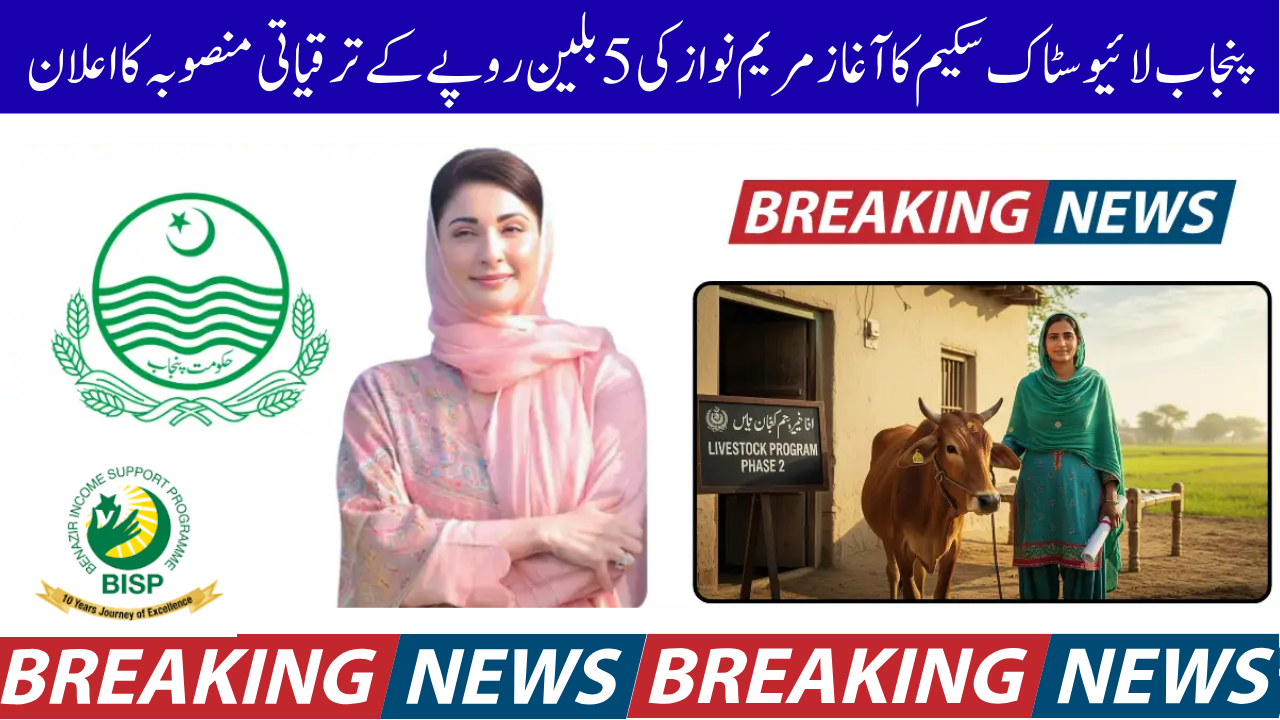
The Punjab Livestock Scheme is a bold new program launched in 2025 under the leadership of Maryam Nawaz that aims to improve rural life via strategic investment in cow rearing, veterinary services, and revenue creation. With Rs. 5 billion devoted to this initiative, the emphasis is on sustainable livestock expansion and strengthening rural populations, particularly women.
This is not simply another welfare program; it represents a shift in development approach. The initiative aims to address both current needs and long-term agricultural resilience by improving access to livestock, healthcare, and training in Punjab’s rural districts.
Major rural investment in dairy and cattle farming.
The initiative stresses providing high-quality animals to rural communities. These include improved breeds of cattle, goats, and local fowl. The goal is to construct self-sustaining microfarms that can reliably produce milk, meat, and eggs.
With agriculture accounting for more than 70% of the regional economy, this sector-focused plan has the potential to provide long-term food and economic stability.
You can read more:Check 8171 BISP Online Registration and Latest Payment Updates for September 2025.
Program Overview
• The project is led by Maryam Nawaz and is scheduled to launch in 2025.
• It involves a total investment of Rs. 5 Billion.
• Key sectors covered include Dairy, Poultry, Goat Farming, and Veterinary Services.
• The main beneficiaries are rural women and low-income farmers.
• Services provided consist of free livestock, training, and mobile vet units.
• Long-term goals are income generation, food security, and rural development.
• The implementation scope extends across rural and semi-rural areas of Punjab.
| Key Element | Details |
|---|---|
| Project Lead | Maryam Nawaz |
| Year of Launch | 2025 |
| Total Investment | Rs. 5 Billion |
| Sectors Covered | Dairy, Poultry, Goat Farming, Veterinary Services |
| Target Beneficiaries | Rural women, low-income farmers |
| Services Offered | Free livestock (cows, goats, hens), training, mobile vet units |
| Core Objective | Income generation, food security, and rural uplift |
| Gender Inclusion Focus | Direct livestock ownership for women to boost income and empowerment |
| Infrastructure Support | Mobile veterinary units, feed centers, free vaccinations & medicines |
| Implementation Areas | Rural and semi-rural areas of Punjab |
Women Farmers at the Centre of the Plan
The active participation of rural women is a fundamental feature of this project. Maryam Nawaz has stated that ladies in communities will receive cattle directly, making them both owners and earners. This minor but significant shift will help close the rural gender income gap.
Access to productive animals for free can provide a steady source of household income for thousands of women, particularly those without land or jobs.
You can read more: BISP 8171 SMS Provides Step-by-Step Assistance for Receiving 8171 Payments Easily
Modern Infrastructure for Animal Health
A portion of the Rs. 5 billion funding is being used to construct amenities like feed centers and mobile veterinary services. These units will go to isolated communities to provide free immunizations, medication, and diagnostic services. For many farmers, this will be the first time their animals have received regular treatment.
Such infrastructure improvement attempts to decrease animal illness losses while increasing overall output.
Cattle and Poultry Distribution Highlights:
• Large-scale distribution of productive livestock to underserved rural households.
• Free provision of cows and goats to smallholder families.
• Distribution of native hens for household poultry farming.
• Regular veterinary checkups for animal health and output improvement.
• Aim to create an affordable protein source and enhance community nutrition.
Veterinary Access in Remote Villages
Many rural households struggle to afford animal healthcare. This is when mobile veterinary units come in. These trucks are fully supplied with vaccinations, diagnostic gear, and trained personnel who will visit locations where veterinary services are generally unavailable.
With this, animal death rates are predicted to fall as production rises, resulting in higher returns for farmers.
You can read more: 8171 New Registration Process for New and Existing Beneficiaries Check Documents, Steps, and FAQs.
Improving Food Production Locally
This effort increases food supply lines by encouraging rural communities to produce their own milk, eggs, and meat. In the face of global inflation and food shortages, localized manufacturing helps to minimize reliance on imports while stabilizing home markets.
It also ensures that even the most impoverished households have access to adequate nourishment.
Farmers’ Training and Awareness Campaigns
• The development program includes capacity-building workshops for farmers, in addition to animal handouts.
• Training modules cover animal nutrition, feeding practices, breeding techniques, animal selection, early disease detection, and proper animal handling.
• These skill-building efforts are designed to ensure farmers maximize the benefits from the livestock they receive.
You can read more: BISP September Payment Delay? Use CNIC and SMS 8171 to Track Your Status.
Long-Term Economic Benefits for Rural Punjab.
This is not a one-time endeavor; it is part of a long-term economic restructuring strategy for rural communities. Farmers may generate money all year round by developing sustainable micro-livestock operations.
It also promotes community-based business, eliminates unemployment, and revitalizes the rural economy.
Conclusion
This livestock-based rural improvement strategy is a smart step toward addressing long-standing economic issues in Punjab’s communities. It promotes long-term income, gender equality, and regional food security by integrating hands-on resources, training, and healthcare access. If carried out successfully, it has the potential to serve as a national model for development through livestock farming.