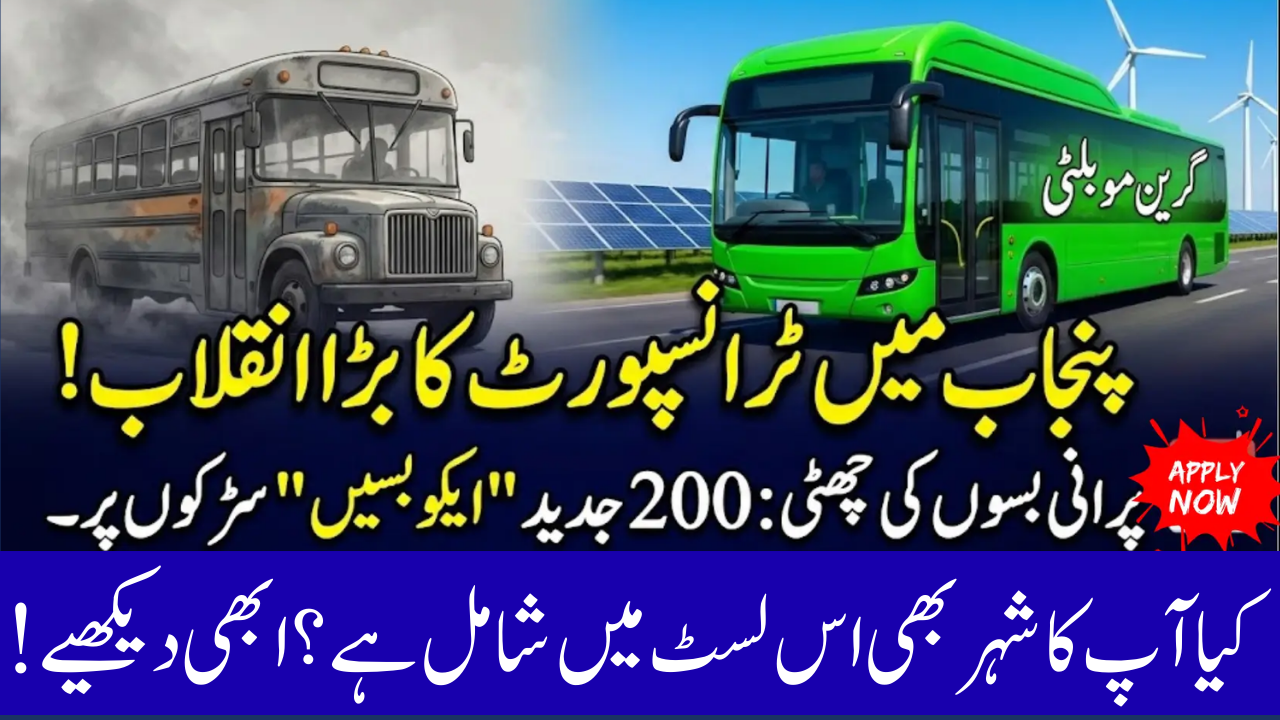
Electric Shift in Punjab
Punjab Electric Shift’s urban environment is about to undergo a significant change. The Punjabi government is launching its “Green Mobility” campaign in an effort to move past the days of loud, smoke-emitting transportation. This is a comprehensive commitment to changing the way the average person travels and cleaning up the air, not simply a straightforward car modification.
With the formal debut scheduled for December 19, 200 cutting-edge electric buses are prepared to revolutionize public transportation by providing a respectable and advanced substitute for conventional commuting.
You can read more: December 2026 Benazir Social Protection Wallet BISP 8171 Beneficiaries’ New SIM System
Reaching Out: Beyond the Provincial Capital
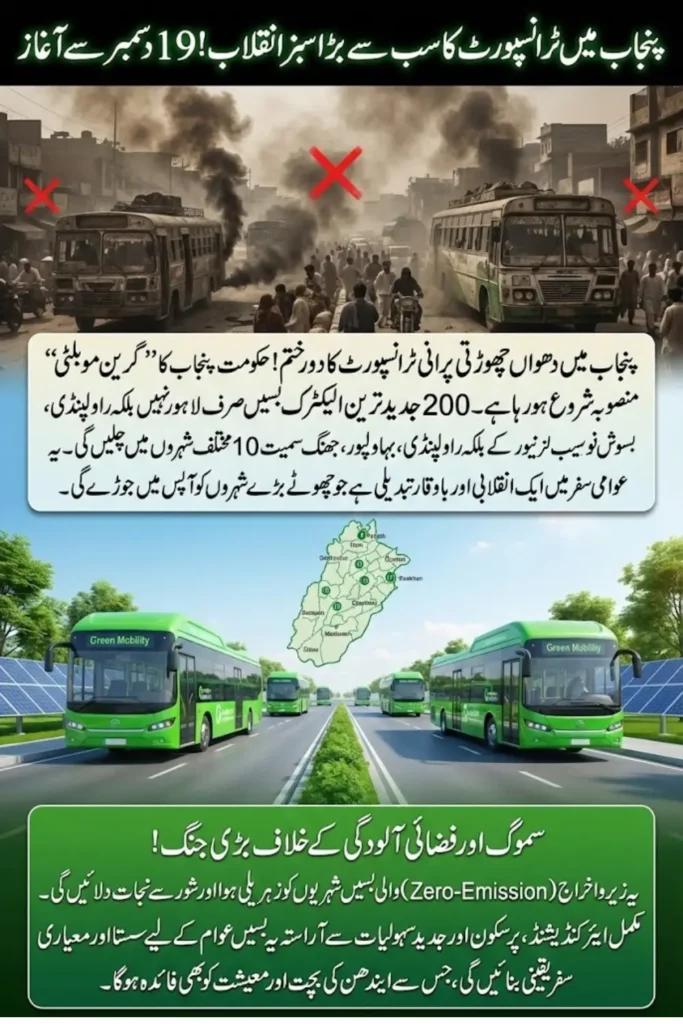
Although similar programs have frequently focused on Lahore, this second phase is extremely inclusive. Ten different cities, ranging from industrial centers to smaller neighborhoods, have been selected by the government as needing an organized transportation system for a considerable amount of time.

• New Green Hubs are established in two regions: Northern & Central (Rawalpindi, Chakwal, Jhelum, Gujar Khan) and Southern & Western (Bahawalpur, Rahim Yar Khan, Rajanpur, Bahawalnagar, Jhang, Toba Tek Singh). • Infrastructure developments include high-speed charging ports and dedicated lanes.
• The aim is to facilitate punctual and stress-free commuting for students in Bahawalpur and office workers in Rawalpindi.
| Feature | Details |
| Fleet Size | 200 Advanced Electric Buses (Initial Phase) |
| Launch Date | December 19, 2025 (Official Rollout) |
| Flat Fare | Rs 20 per trip |
| Free Travel | Students, Senior Citizens, and Differently-abled individuals |
| Target Cities | Rawalpindi, Bahawalpur, Jhelum, Jhang, Rahim Yar Khan, and 5 others |
| Onboard Tech | High-definition CCTV, GPS Tracking, Wi-Fi, and USB Ports |
| Climate Control | Fully air-conditioned for extreme summer comfort |
| Infrastructure | High-speed charging ports and 41 modern dedicated depots |
The Economic Advantage: Fuel and Money Savings
For the province’s economy, switching to electric vehicles (EVs) is a brilliant move. Conventional diesel buses are infamous for requiring a lot of maintenance and having erratic fuel prices. Electric buses, on the other hand, have fewer moving parts, which lowers repair costs and enables the government to maintain reasonable tariffs.
The province is contributing to lessening the country’s reliance on pricey imported fuel by reducing its use of diesel. It’s a self-sustaining cycle: cheaper prices result in better services, which attract more travelers and reduce the need for government assistance.
You can read more: BISP 8171 Removal in 2026: Common Errors That Cause Rejection
Easier Breathing: A Way to Address the Smog Issue
“Smog Season” has become an annual health risk for Punjabi citizens. This environmental problem is directly addressed by these 200 buses. They keep tons of carbon and harmful pollutants out of the atmosphere since they emit no tailpipe emissions.
The “silent” advantage goes beyond the quality of the air. In dense city centers, the loud scream of conventional engines is replaced by the calm hum of an electric motor, greatly reducing noise pollution.
A Superior Experience for Regular Travelers
The government wanted to improve public transportation to the point that people would prefer it to private vehicles or bicycles. Features of the new fleet include:
• **Climate Control:** Fully air-conditioned interiors designed for the harsh summers in Pakistan.
• **Inclusivity:** Features ramps and designated spaces for the elderly and differently-abled individuals.
• **Security:** Utilizes high-definition CCTV and GPS tracking to ensure passenger safety and maintain route discipline.
Constructing Future “Smart Cities”
This project is creating a digital backbone for our cities rather than merely transporting people. Commuters will be able to follow buses in real time thanks to the rollout’s integration of mobile apps and digital ticketing. As charging stations proliferate around the province, this action also encourages the business sector to invest in EV infrastructure.
You can read more: Starting in January 2026, the Benazir Kafalat Program would increase the quarterly payment to Rs 14500.
In conclusion
This initiative is really about social mobility. Affordable transportation serves as a link to greater prospects for both university students in Jhelum and laborers in Rajanpur. Punjab is using green energy to power its economy by establishing a dependable connection between households, schools, and workplaces.

FAQs
1. How will the “Smog Season” benefit from the electric bus project?
Conventional diesel buses are a significant source of particulate matter (RsPM_{2.5}Rs), which contributes to the yearly smog problem. Every year, about 73 tons of carbon emissions are avoided by each electric bus.
These buses greatly lessen the harmful smog in crowded cities like Lahore and Rawalpindi since they emit no exhaust emissions.
2. Outside of Lahore, which cities are part of the expansion?
Inclusion in Northern, Central, and Southern Punjab is the main goal of the “Green Mobility” initiative. Important hubs consist of:
• Climate control is ensured with fully air-conditioned interiors suitable for harsh summers in Pakistan.
• Features inclusivity measures, such as ramps and dedicated spaces for the elderly and differently-abled individuals.
• Security is enhanced with high-definition CCTV and GPS tracking for passenger safety and route discipline.
• Geographical coverage includes Northern/Central regions: Rawalpindi, Chakwal, Jhelum, and Gujar Khan; Southern/Western regions: Bahawalpur, Rahim Yar Khan, Rajanpur, Bahawalnagar, Jhang, and Toba Tek Singh.
3. What features are provided for travelers in terms of security and accessibility?
The fleet is intended to serve as a “Smart City” backbone. Every bus has motorized ramps for handicapped access, CCTV for passenger safety, and GPS tracking for real-time position via smartphone apps. The interiors have anti-slip flooring and designated areas for senior passengers for increased convenience.