A Complete Guide Benazir Taleemi Wazaif: Updates for January 2026
The Benazir Taleemi Wazaif initiative stands as a cornerstone of Pakistan’s social safety net, specifically focusing on human capital development through education. As of January 4, 2026, the program has introduced significant enhancements to support the educational journey of children from underprivileged backgrounds.
This Conditional Cash Transfer (CCT) program operates under the umbrella of the Benazir Income Support Programme (BISP), aiming to reduce the dropout rate by providing financial incentives to families who prioritize their children’s schooling.
By linking cash assistance to school attendance, the government ensures that the financial burden of education—such as uniforms, books, and transport—does not hinder a child’s future. The January 2026 cycle marks a pivotal shift toward increased stipend amounts and a more streamlined, digital-first approach to fund distribution.
You can read more: Akhuwat Foundation Interest-Free Loan 2026: Needs, How to Apply, and Complete Information
Core Eligibility Criteria for 2026
To maintain the integrity of the program and ensure that aid reaches the most deserving, BISP has established strict eligibility benchmarks. For the January 2026 quarter, the following conditions apply:
-
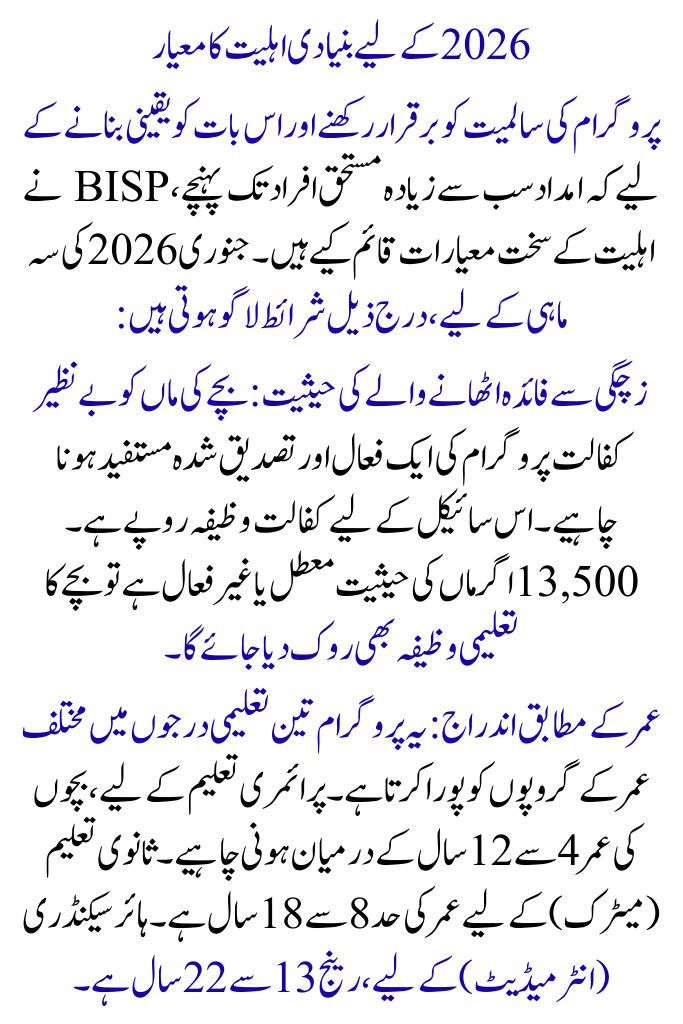
Maternal Beneficiary Status: The child’s mother must be an active and verified beneficiary of the Benazir Kafaalat program. For this cycle, the Kafaalat stipend stands at Rs. 13,500. If the mother’s status is suspended or inactive, the child’s educational stipend will also be halted.
-
Age-Appropriate Enrollment: The program caters to different age groups across three educational tiers. For Primary education, children must be between 4 and 12 years old. For Secondary education (Matriculation), the age bracket is 8 to 18 years. For Higher Secondary (Intermediate), the range is 13 to 22 years.
-
The 70% Attendance Rule: This is the most critical condition. To trigger the quarterly payment, the student must maintain a minimum attendance of 70% at their respective educational institution. Schools are required to report this data digitally to the BISP database.
-
Institutional Recognition: The student must be enrolled in a government school or a private school that is formally recognized and registered with the BISP program.
Revised Stipend Structure for January 2026
The government has revised the stipend amounts to counter inflationary pressures and further incentivize female education. The current structure reflects a clear “gender-positive” bias, offering higher rewards for girls to bridge the literacy gap in rural and semi-urban areas.
You can read more: January 2026 BISP 8171 Web Portal: Verify Your Eligibility and Payment Status Online
| Education Category | Class Level | Quarterly Stipend (Boys) | Quarterly Stipend (Girls) |
| Primary | Class 1 to 5 | Rs. 2,500 | Rs. 3,000 |
| Secondary | Class 6 to 10 | Rs. 3,500 | Rs. 4,000 |
| Higher Secondary | Class 11 to 12 | Rs. 4,500 | Rs. 5,000 |
| Graduation Bonus | Upon Class 5 Completion | N/A | Rs. 3,000 (One-time) |
Detailed Registration and Enrollment Process
For families looking to enroll their children for the first time in the 2026 session, the process has been designed to be transparent. It requires coordination between the family, the school, and the BISP administration.
Step 1: Acquisition of the Enrollment Slip
The mother must visit the nearest BISP Tehsil Office. Upon providing her CNIC, she will be issued a “Taleemi Wazaif Enrollment Slip.” This document is unique to each child.
Step 2: Institutional Verification
This slip has to be brought to the child’s present school by the parent. The child’s class information, section, and the school’s Education Management Information System (EMIS) code must be filled out by the headmaster or principal. For the slip to be deemed legitimate, it needs to be signed and stamped.
You can read more: January 2026 BISP 8171 Web Portal: Verify Your Eligibility and Payment Status Online
Step 3: Document Submission and Biometrics
The verified slip is then returned to the BISP office. Along with the slip, the mother must provide her original CNIC and the child’s NADRA-issued B-Form (Child Registration Certificate). This ensures that the child’s age and identity are legally verified.
Step 4: SMS Confirmation
Once the data is entered into the National Socio-Economic Registry (NSER), the system processes the application. Successful registration is confirmed via an official SMS from the shortcode 8171.
Payment Disbursement and Digital Integration
Starting January 20, 2026, the Taleemi Wazaif installments will be disbursed alongside the regular Kafaalat payments. In a major move toward “Digital Pakistan,” BISP has expanded its payment methods.
-
Digital Wallets: Beneficiaries in selected districts can now receive funds directly into mobile wallets like JazzCash or Easypaisa, reducing the need to travel to bank branches.
-
Biometric Verification: To prevent fraud, all withdrawals require the mother’s live thumbprint verification at POS (Point of Sale) retailers or designated ATMs of partner banks (HBL or Bank Alfalah).
-
Graduation Incentives: Girls completing the 5th grade will see an additional Rs. 3,000 credited to their accounts as a one-time bonus to encourage transition into secondary school.
You can read more: Benazir Taleemi Wazaif 2026: Registration, Stipends, and Eligibility
Critical Deadlines and Compliance
• January 20, 2026: Start date for the quarterly payment rollout.
• Dynamic Survey Update: Beneficiaries must update socioeconomic data at a BISP office if it hasn’t been done in the last three years to avoid temporary suspension.
• Quarterly Attendance Upload: Parents need to confirm that their child’s school submits the attendance report by the end of the month prior to ensure timely payment processing.
In Conclusion
The government’s dedication to education is seen in the Benazir Taleemi Wazaif January 2026 update through higher stipends and improved digital efficiency. The initiative guarantees that students from worthy households continue their education by tying financial help to a 70% attendance record.
To obtain these essential educational subsidies and provide a better future for their children, recipients must keep informed about the 8171 SMS alerts and finish the biometric verification.

FAQs
1. What should I do if my child’s stipend is blocked despite having 70% attendance?
If attendance is sufficient but the payment is blocked, visit your local BISP office to verify if your Dynamic Survey is up to date. Occasionally, technical errors in the school’s EMIS code entry can also cause delays, which can be corrected by resubmitting a fresh verification slip.
2. Can a child receive a stipend if they are enrolled in a private school?
Yes, provided the private school is registered with the District Education Authority and has a valid EMIS code or is recognized by the BISP program. You should check with the school administration before attempting the registration process.
3. Is there any fee for the BISP Taleemi Wazaif registration or the enrollment slip?
No, the entire process—from obtaining the slip to the final registration—is completely free of cost. If any official or middleman demands money for this service, it should be reported immediately to the BISP helpline at 0800-26477.