
As of 2026, the convergence of technology and social welfare in Pakistan has reached a pivotal moment, exemplified by the evolution of the 8171 program.
Originally designed as a basic cash-transfer mechanism under the Benazir Income Support Programme (BISP), it has transformed into a comprehensive “Social Registry.” This transition marks a significant advancement in providing financial safety nets for millions of households amidst an increasingly digital economy.
The 2026 New Registration process is highlighted as a crucial step for citizens seeking assistance, ensuring that they can secure a safety net in this new economic landscape.
The article delves into an extensive analysis of the protocols involved in the registration, introduces a novel “Dynamic Survey” methodology intended to enhance outreach and efficiency, and outlines a detailed roadmap designed to ensure that no deserving individual is overlooked in this initiative.
You can read more: http://8171.bisp.gov.pk Online Portal for December Payment Verification with CNIC Number: Step-by-Step Guide 2025
1. The Evolution of 8171 in 2026
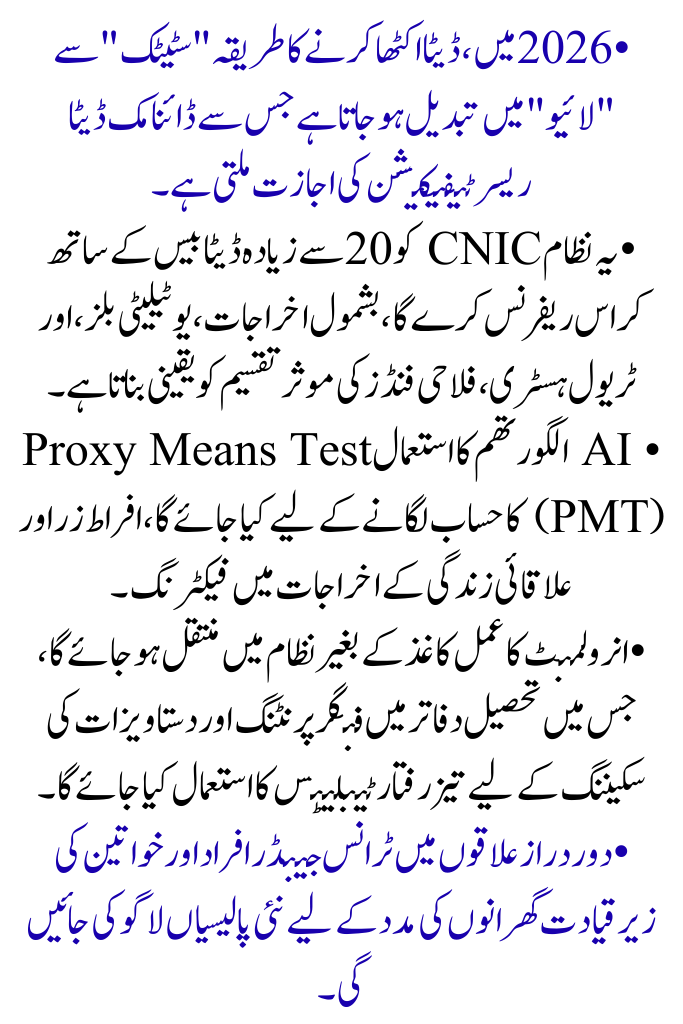
• In 2026, the data collection approach changes from “Static” to “Live,” allowing for Dynamic Data Recertification.
• The system will cross-reference CNIC with over 20 databases, including expenses, utility bills, and travel history, ensuring efficient distribution of welfare funds.
• AI algorithms will be used to calculate the Proxy Means Test (PMT), factoring in inflation and regional living costs.
• The enrollment process will transition to a paperless system, utilizing high-speed tablets for fingerprinting and document scanning in Tehsil offices.
• New policies will be implemented to support transgender individuals and women-led households in remote areas.
• The system will cross-reference CNIC with over 20 databases, including expenses, utility bills, and travel history, ensuring efficient distribution of welfare funds.
• AI algorithms will be used to calculate the Proxy Means Test (PMT), factoring in inflation and regional living costs.
• The enrollment process will transition to a paperless system, utilizing high-speed tablets for fingerprinting and document scanning in Tehsil offices.
• New policies will be implemented to support transgender individuals and women-led households in remote areas.
2. Understanding the “Dynamic Survey” (NSER 2.0)
• Applying for the 8171 New Registration 2026 involves participation in the National Socio-Economic Registry (NSER) 2.0, which serves as a detailed socio-economic map.
• Key registration pillars include:
– **Demographics:** Information on family size, ages, and education levels.
– **Health Status:** Identification of chronic illnesses or disabilities needing additional financial support.
– **Housing Conditions:** Evaluation of housing type (Katcha vs. Pacca) and access to clean water.
– **Economic Assets:** Ownership details of livestock, small tools, or bicycles.
• Key registration pillars include:
– **Demographics:** Information on family size, ages, and education levels.
– **Health Status:** Identification of chronic illnesses or disabilities needing additional financial support.
– **Housing Conditions:** Evaluation of housing type (Katcha vs. Pacca) and access to clean water.
– **Economic Assets:** Ownership details of livestock, small tools, or bicycles.
3. Step-by-Step Registration Roadmap for 2026
For those looking to register for the first time or renew their status, follow this modernized 2026 workflow:
You can read more: http://2026 Tracking Portal 8171 To Verify Eligibility for 13500 via Digital Mobile Account: A Stepwise Approach
Step 1: The Preliminary SMS Check
• Use the 8171 SMS Gateway before traveling to save time and fuel.
• Send your 13-digit CNIC to 8171 to receive one of three responses in 2026:
– “Eligible”: Go to the nearest bank for payment.
– “Record Not Found”: Visit a Registration Center for a survey.
– “Under Review”: Your data is currently being cross-checked with NADRA.
• Send your 13-digit CNIC to 8171 to receive one of three responses in 2026:
– “Eligible”: Go to the nearest bank for payment.
– “Record Not Found”: Visit a Registration Center for a survey.
– “Under Review”: Your data is currently being cross-checked with NADRA.
Step 2: Visiting the Digital Registration Center
• For conducting a survey, visit your local BISP Tehsil Office.
• In 2026, CRM desks have been introduced in these centers for quick grievance handling.
• Tuesdays and Wednesdays are the least crowded days for registration at these centers.
• In 2026, CRM desks have been introduced in these centers for quick grievance handling.
• Tuesdays and Wednesdays are the least crowded days for registration at these centers.
Step 3: Biometric Identity Verification
Once your survey data is entered, you must undergo biometric verification. This ensures that no one can steal your identity or claim your funds. If your fingerprints are worn out (common in elderly citizens or manual laborers), 2026 protocols allow for Iris Scanning (eye recognition) at specialized centers.
Step 4: Digital Approval Notification
Once your PMT score is calculated and verified (usually within 15 to 30 days), you will receive a final confirmation SMS from 8171. This message will contain your “Registration ID,” which you should keep confidential.
You can read more: http://Naujawan Hunarmand Program 2026: Punjab Aims to Train 2,300 Young Individuals as Skilled Professionals in Just One Year
4. Mandatory Document Checklist (2026 Edition)
To ensure a “one-visit” success, carry the following original documents. Note that in 2026, digital versions (e-CNICs) via the NADRA app are also officially accepted.
- Smart CNIC: A computerized national identity card is mandatory.
- Family Registration Certificate (FRC): This helps the 8171 system link you to your children and spouse.
- School Enrollment Proof: If you have children aged 5–18, bring their school admission slips to qualify for the Taleemi Wazaif (Education Bonuses).
- Disability Certificate: If you have a physical or mental impairment, ensure it is mentioned on your CNIC with the “Special Person” logo.
5. Common Challenges and Professional Solutions
• In 2026, hurdles may still arise despite advancements in technology.
• The “Sim Ownership” issue is a leading cause for 8171 rejection; applicants must ensure their mobile SIM is registered in their name.
– **Solution**: Register the number to your own CNIC before initiating the 8171 process.
• A “High Utility Bill” can disqualify applicants if the monthly bill exceeds a certain adjusted threshold, indicating a higher standard of living.
– **Solution**: If the high bill is due to a one-time error or shared meter, a “Grievance Appeal” can be filed at the BISP Grievance Portal.You can read more:
• The “Sim Ownership” issue is a leading cause for 8171 rejection; applicants must ensure their mobile SIM is registered in their name.
– **Solution**: Register the number to your own CNIC before initiating the 8171 process.
• A “High Utility Bill” can disqualify applicants if the monthly bill exceeds a certain adjusted threshold, indicating a higher standard of living.
– **Solution**: If the high bill is due to a one-time error or shared meter, a “Grievance Appeal” can be filed at the BISP Grievance Portal.You can read more:
6. Benefits of Successful Registration
Being part of the 8171 database opens doors to multiple government “Safety Nets”:
- Kafaalat Cash Transfer: A quarterly stipend to help with basic kitchen expenses.
- Nashonuma (Health & Nutrition): Extra funds for pregnant women and lactating mothers to prevent stunting in children.
- Fuel/Energy Subsidies: Targeted relief on petrol and electricity for those with a PMT score below 25.
- Emergency Relief: In case of floods or natural disasters, registered 8171 users are the first to receive emergency aid.
7. Security Warning: The 2026 “Anti-Scam” Protocol
As the program grows, so do the scammers. Protect yourself with these rules:
- Only 8171: No other number is authorized to send you eligibility messages. Ignore “03xx” numbers claiming you won a prize.
- Never Pay for Registration: If an official or an agent asks for “chai pani” or a fee, report them immediately to the BISP helpline (0800-26477).
- Keep Your PIN Safe: Your ATM/Bank PIN is your money. Do not share it with anyone, even BISP staff.
You can read more: http://Naujawan Hunarmand Program 2026: Punjab Aims to Train 2,300 Young Individuals as Skilled Professionals in Just One Year
In conclusion
The 8171 New Registration 2026 is more than just a bureaucratic process; it is a bridge to a better life. By embracing the digital shift, providing accurate data, and staying informed through official channels, official page you can ensure that your family remains protected under Pakistan’s umbrella of social care.
In 2026, technology has made it possible to bring dignity and transparency to social welfare. Make sure you take the first step today—check your status, visit the center, and secure your rights.

FAQs
1: Can I register for 8171 if I am a freelancer or working in the Gig Economy?
Yes. The 2026 criteria have been updated to include informal workers. As long as your total verifiable monthly income falls below the poverty threshold and you do not have significant taxable assets, you are encouraged to apply for the NSER survey.
2: I moved to a different city in 2026. Do I need to re-register?
You do not need a new registration, but you must update your address in the NSER database. Visit the BISP office in your new city with your updated utility bill so that your “Payment Point” can be transferred to your current location.
3: What is the “Iris Recognition” option mentioned in the 2026 guide?
For citizens whose fingerprints are not readable due to age, skin conditions, or labor-intensive work, BISP has introduced eye-scanning (Iris) technology in 2026. If the biometric machine fails three times, you can request an Iris scan to complete your verification and receive your payment.